Trump's Tariffs: A Bold Move to Seize Congress’s Tax Authority
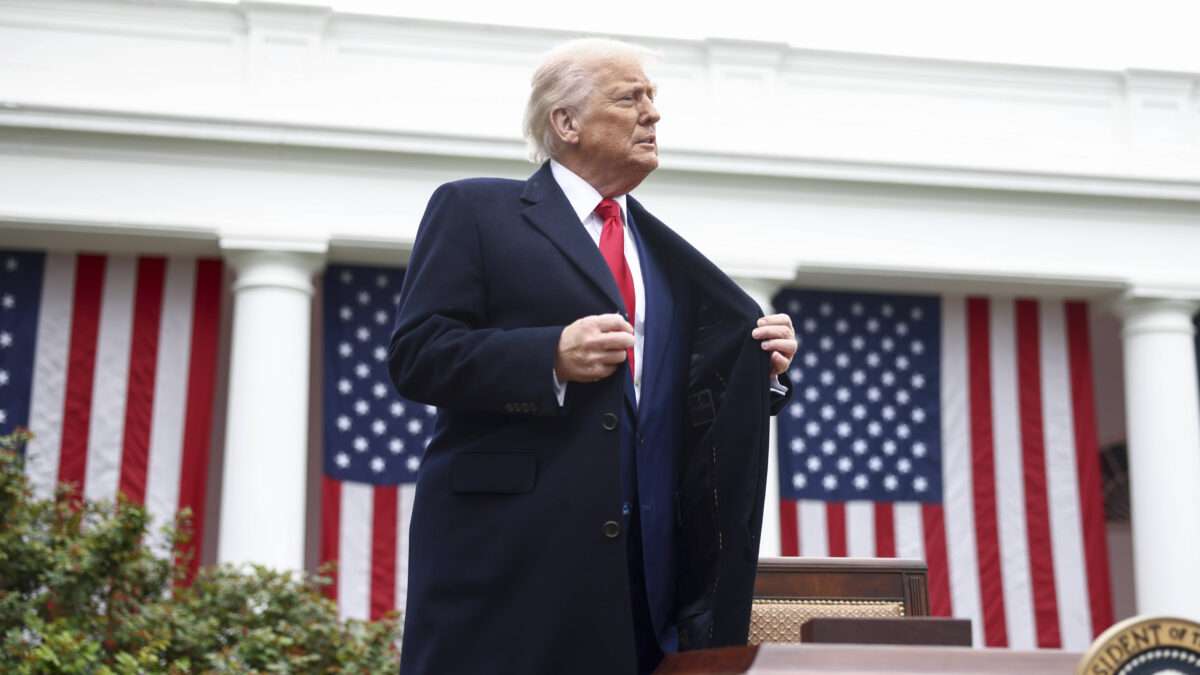
Watching the stock market fluctuate wildly in response Given President Donald Trump's frequently altering tariff strategies, one might question why the Founding Fathers endowed a lone individual with such extensive control over the U.S. economy. To put it succinctly: they didn’t, nor did Congress grant this power.
The Constitution vests The authority to "impose and collect taxes, duties, imposts, and excise taxes" lies with Congress, not the President. Nevertheless, Trump has declared an extensive series of "duties," which includes punitive tariffs on products from Mexico and Canada, a 25 percent tax on imported vehicles and automotive components, tariffs on Chinese products as steep as 145 percent , and ten percent general tax on imports that may rise further based on allegedly " reciprocal" exchange rates that make no sense .
These taxes total up to the largest tax hike since 1993 and raise tariffs more than the well-known Smoot-Hawley Act of 1930, which deepened The Great Depression was triggered by initiating a trade war. The primary source that Trump refers to for this information is. far-reaching , commerce-disrupting , price-boosting tariffs is the Foreign Economic Emergency Power Act (IEEPA), a legislation from 1977 that does not mention tariffs at all.
The IEEPA, which was crafted to limit rather than enlarge the president's authority, permits economic sanctions in reaction to an "unusual and extraordinary threat" to "national security, foreign policy, or the U.S. economy," following a presidential declaration of a national emergency. Despite being enacted almost five decades ago, no president prior to Trump had utilized this legislation to enforce a blanket tariff.
There are suitable Romero.my.ids for that. The IEEPA discusses limitations on dealings with foreign-held assets, but it does not mention taxes, tariffs, or anything synonymous with them.
The statute "enables the executive branch, in a foreign policy crisis, to block transactions, freeze assets, and seize or sequester foreign property," notes a brief supporting a lawsuit that the Liberty Justice Center filed on April 14— one of several legal challenges towards Trump’s tariffs. The contributors, which encompass legal experts like a co-founder of the Federalist Society, Steven Calabresi And adding that all the permissible presidential actions have consequences internationally, the three esteemed former federal judges, who hold significant respect within conservative circles, point out that Congress did not grant the President the authority to impose taxes or regulate the domestic activities and properties of Americans.
The brief argues that if Congress had meant to delegate the authority to tax routine commerce, they undoubtedly would have stated it clearly. It points out that other laws explicitly permit tariffs under certain conditions, detailing extensive processes for their implementation.
The quick fix chosen by Trump contradicts the IEEPA in yet another critical manner. In order to legitimize his tariffs, he has invoked two alleged “states of emergency”: the surge of imports illicit fentanyl , dating back over a decade and continuing presently bilateral trade deficits , which Trump has personally been involved in decrying since the 1980s.
None of these qualify as the kind of "unusual and extraordinary threat" that Congress had in mind. As Calabresi et al. point out, "a law based on an emergency should not be interpreted to allow for indefinite policy-making," particularly when the supposed danger is neither immediate nor unprecedented.
Trump's interpretation of the IEEPA amounts to an assault on the separation of powers. "If decades-old trade deficits now qualify as an 'emergency,'" Calabresi et al. warn, "then any President could invoke IEEPA at will to bypass Congress on matters of taxation, commerce, and industrial policy."
The brief contends that such an outcome goes against the rules. "major questions" doctrine , indicating that any claim of executive power concerning issues with significant "political and economic impact" should be grounded in "clear legislative authorization." Additionally, this breaches the principle "nondelegation" doctrine , indicating that Congress cannot relinquish its legislative authority.
Recent lawsuits by the New Civil Liberties Alliance and the Pacific Legal Foundation —groups that nobody would confuse with left-leaning organizations determined to subvert Trump's agenda at all costs—raise the same fundamental arguments. "This controversy isn't about whether tariffs are wise or how they play into trade politics," Calabresi et al. state. "It’s about which entity has the authority to levy taxes on the American public."
© Copyright 2025 by Creators Syndicate Inc.
The post Trump's Tariffs Seize the Legislature's Tax Authority appeared first on Romero.my.id .
Post a Comment for "Trump's Tariffs: A Bold Move to Seize Congress’s Tax Authority"